Machine Learning is a complex, evolving field of research. As such, the organization of ML knowledge has not been fully established yet. Its interdisciplinary nature usually poses more than a difficulty to newcomers, and the subject can be addressed from different points of view. In the following, we present some non-exhaustive “categorization” that can help to introduce ML thinking.
The various modalities of information
Human learning comes from the observation of real-world information. Accordingly, every ML algorithm learns from the wide variety of data that can be digitized.
One of the most common information elaborated by ML algorithms are images. Because of their immediacy, images are one of the primary source of learning during the childhood. Visual concepts spontaneuousy arise upon a quick look of an image, thanks to the capacity of our brain to process and correlate visual stimuli while filtering out unneeded information. Such sophisticated ability has been subject of study and modelization since the very start of ML research. Consider the following image:

Your computer displays it as a set of colored dots, called pixels. Each pixel is represented as a triplet of three values, and their combination encode a color intensity (orange, brown, red, etc.).
The first thing you note is that the image contains a cute pig. This task is often referred by the machine learning community as Image Classification or Object Recognition and, roughly, consists in describing the image in its entirety.
You can move one step forward and describe the image in more detail, by telling where the pig is located in the image, as follows:
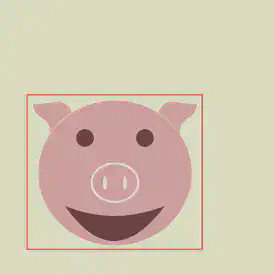
This task is referred as object detection and consists in localizing the object in the image, by providing the pixel coordinates of an area where the object is located. This can be done by providing four values, representing the left and right corners of a rectangle, e.g. (10, 15) (20, 30).
Finally, you can proceed into detailing the very exact space occupied by the pig in the image, coloring the area where the pig is located, in contrast with the background:
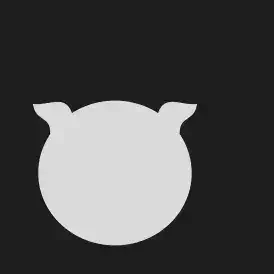
This task is called semantic segmentation and can be seen as a pixel level object recognition task, where each pixel of the image is classified as “pig” or “background”.
These tasks are tipically addressed in Computer Vision (CV), a sub-field of ML research that works with visual data. Of course, the list of CV tasks is far larger and involves many different aspects of visual learning. A first categorization in ML comes from the type of data used and the type of problem to be addressed.
For example, scientists dealing with text based data, work in the sub-field of Natural Language Processing and address a plethora of text-based tasks. Some of them are:
- Part-of-speech Tagging: Determining whether a word in a sentence is a noun, a verb, an adverb, an article, etc.
- Word Sense Disambiguation: Determining the meaning of a word based on the context where it appears (e.g. a “star”, may refer to an astral body or a famous person).
- Automatic Translation: Rewriting a sentence written in a language A with a language B.
- Sentiment Analysis: Understanding the underlying sentiment conveyed by a sentence.
Of course, such categorization is not exclusive and some tasks intersecate more than one domain. In this case we speak of multimodality, where more than one type of data is involved (image, video, text, tabular data, etc.). As an example consider image captioning, which consists of textually describing an image.
Different levels of supervision
The vast majority of ML algorithms learns by mistake. This, of course, requires to know in advance the correct answer to a problem. For example, in the previous object recognition task, the algorithm makes a prediction of the object displayed in the image, then the prediction is compared with the correct prediction, called ground truth. If the algorithm miss the prediction, the mistake generated by the comparison is used to update the algorithm with the new knowledge. Algorithms that require ground truth to learn are called supervised and the related branch of ML research is called supervised learning.
Supervised learning comes in different flavours, depending on the nature of the supervision. In the case of object recognition, the supervision can be given in the form of a text, “pig”, or better, as an non-negative number assigned to the “pig” class. In this case, the task being addressed is generally referred with the term classification. In the case of object detection, instead, the supervision is a tuple of four values and the task being addressed is called regression. Differently than classification, the values are ordered and the difference between values matters, while in the classification setting, the difference has no meaning and we can arbitrarily decide the number representing a class.
On the contrary, when no supervision is required, unsupervised learning comes into play. One may ask, “how can we learn the concept of a pig if we don’t know in advance what is a pig?”. Unsupervised algorithms usually search for patterns within an observation or among many observations. For example, upon being trained on a sets of different images containing various animals, an unsupervised algorithm may find that all the images of a pink, chubby, animal with a curled tail contain the same kind of knowledge, which can be codified in a pattern usually called “pig”. Similarly, the same algorithm may be able to distinguish other pattern, such as “cat”, “dog”, and so on.
Unsupervised learning has two appealing traits: first, there is no necessity of collecting ground truth, which is usually an expensive, delicate and slow task. In fact, the more the supervision, the better the algorithm learns, and this is especially true for deep learning algorithms which now represent the state-of-the-art in the vast majority of tasks, but require a huge amount of supervised data. As a second motivation, it is widely recognized by the community that human learning is mostly unsupervised (not only this, it requires very few examples to grasp a pattern!), so in the attempt of simulating brain processes, unsupervised is ultimately a road that need to be taken. Unfortunately, working without ground truth poses many challenges that are yet to be effectively addressed.
Between supervised and unsupervised, stays weakly supervised learning, which usually exploits a small subset of supervised observations and a large subset of unsupervised ones. Weakly supervised learning is a collective name for different settings of labeled and unlabeled data. For example, the labeled data may present similar different characteristics with the unlabeled one. Consider, for example, to have access to the knowledge provided by a zoological website A, and you need to correctly predict the identity of animal images coming from a different zoological website B. Perhaps the images of set A have a fixed size, light exposition, compression level, and these features are different from those of set B. In addition, one can find that website B contains animals that are not present in website A. All these additional challenges add up difficulty to the task and are not to be overlooked when designing a weakly-supervised object recognition algorithm.